Marketing trends 2026: the GEO-first guide to getting cited by AI without losing the human factor
Brand discovery is migrating inside AI answers. Paradoxically, that's exactly what makes human expertise more valuable than ever.
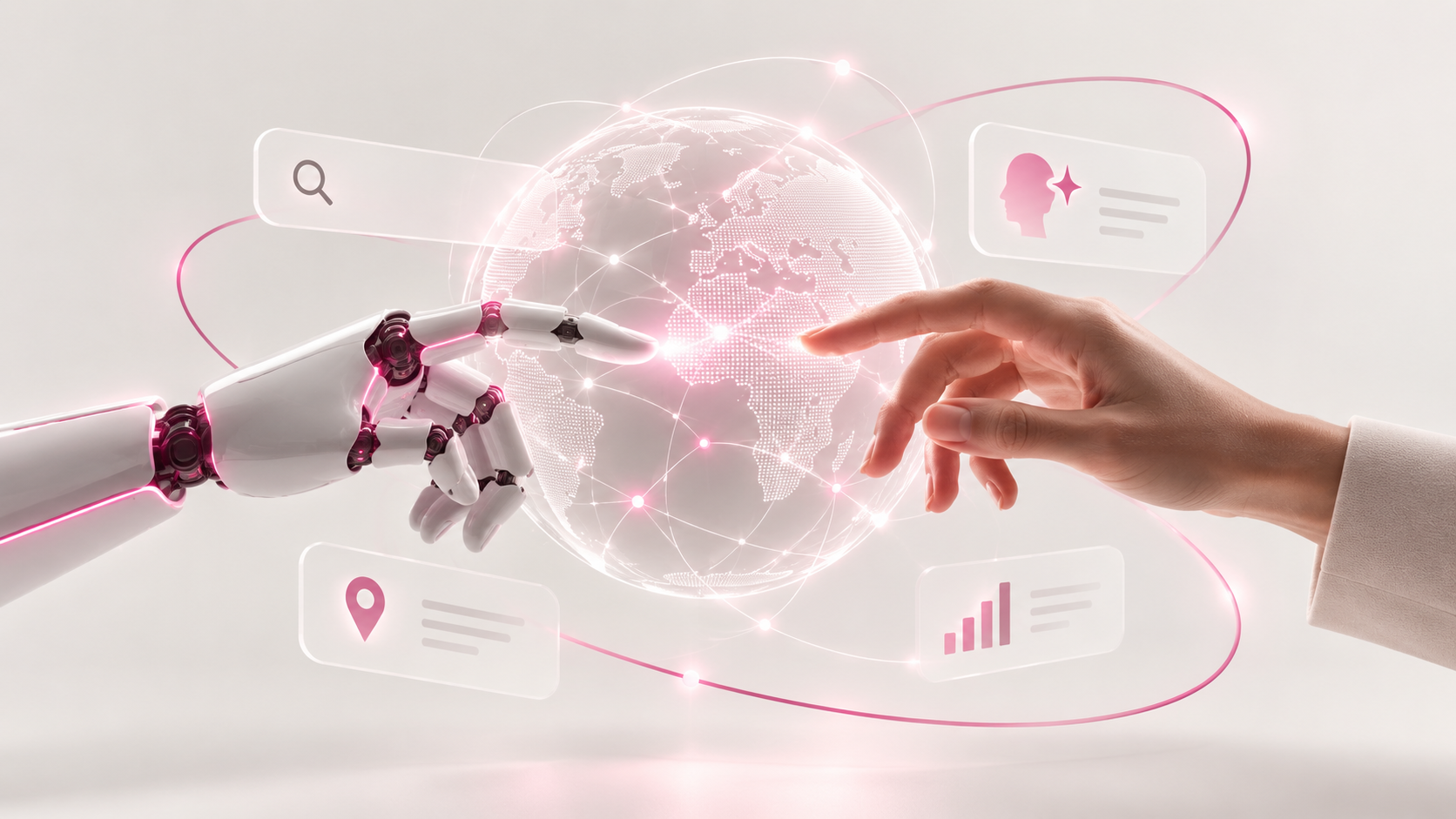
In 2026 marketing revolves around five shifts: from SEO to GEO/AEO (getting cited by AI, not just ranking on Google), a new premium on authenticity, community as a defensive moat for the brand, AI as a creative engine and not just an accelerator, and metrics beyond ranking and traffic. The common thread: technology optimizes, but trust and authority remain a human job.
For years digital marketing had a magnetic north: ranking among the top Google results. That north is shifting. More and more people no longer type keywords into a search bar — they ask full questions to ChatGPT, Gemini, Perplexity, voice assistants. And the answer they get often doesn't even contain a link to click. 2026 marketing isn't a linear evolution of previous trends: it's a change of terrain.
The good news for those who work with competence rather than shortcuts: this terrain rewards exactly what is hard to automate. Let's look at the five trends that matter and, above all, what to actually do about them.
01From SEO to GEO/AEO: getting cited, not just ranked
The acronym to learn this year is GEO — Generative Engine Optimization (often paired with AEO, Answer Engine Optimization). The goal is no longer just appearing among the ten blue links, but being the source the AI cites when it synthesizes an answer for the user.
This isn't niche theory. Google's AI Overviews now appear in roughly one in four searches, up from about one in eight a year earlier. Anyone still optimizing only for traditional ranking is competing for a shrinking slice of attention.
But there's a detail that changes everything for SMEs and professionals: GEO is much less saturated than classic SEO. Keywords tied to generative search have noticeably lower difficulty than their SEO equivalents, and — crucially — they reward real expertise and authority more than domain age or backlink count. A challenger brand with authentic vertical expertise can outrank much bigger competitors.
Structure content to be "extractable": a clear answer up front, self-contained paragraphs, FAQs with schema markup, verifiable data. Run manual audits by asking AI tools what they say about your industry and your brand. GEO isn't won with volume, but with clarity and authority.
02The premium on authenticity (against the flood of generated content)
The more AI fills the web with content, the rarer — and more valuable — anything that sounds genuinely human becomes. As mass-produced text and deepfakes spread, people become more guarded: they look for content that sounds like it was written by someone with a point of view, an experience, a stance.
It shows up in formats too: there's a return to first-person, blog-style and professional-diary content, as an explicit counterweight to automated production. The spotlight on social media shifts from mass reach to meaningful connections — spaces like Reddit, Substack, private groups and newsletters, where trust is built in depth rather than in breadth.
03Community as a "brand moat"
One of the strongest ideas of 2026: community and a sense of belonging become a defensive moat (the so-called brand moat) that reduces dependence on algorithms and ad spend. If the algorithm changes or advertising costs rise, a community that follows you by choice doesn't disappear.
The engine is simple and ancient: people trust people more than they trust brands. Genuinely participating in the niche groups and networks your audience already frequents generates word-of-mouth and advocacy in a way cold advertising cannot replicate. In B2B especially, credibility is built with evidence — real results, concrete case studies — not promises.
04AI as a creative engine, not just an accelerator
The most common misunderstanding is treating AI as a way to do the same things faster. The 2026 shift is different: AI doesn't just make processes quicker, it transforms them at the root, from creativity to commerce, from streaming to omnichannel orchestration.
But — and this is the point that matters — competitive advantage won't come from owning AI tools. Everyone will have those. It will come from the ability to integrate them wisely into creative and strategic processes: knowing when AI is the engine and when human judgment is needed to decide what's right to say, to whom, and why.
05New metrics: beyond ranking and traffic
As a growing share of interactions happen "with no click" — the user gets the answer inside the AI and never visits the website — ranking and traffic stop telling the whole story. KPIs tied to visibility in AI answers, perceived authority and assisted conversions become central, integrating marketing and CRM data into a view genuinely oriented toward return on investment.
In practice: soon every team will monitor how often their brand appears in AI-generated answers, the way they monitor visits and rankings today. Whoever starts measuring it now starts ahead.
Notice the thread running through all five trends. GEO rewards real authority. Authenticity is non-automatable by definition. Communities are built on trust between people. Creative AI needs judgment to decide what's worth saying. New metrics ultimately measure how much you're seen as a reliable source.
It all converges on the same point: technology replicates intelligence — execution, production, optimization. But judgment, experience and trust remain human. In 2026, the winner isn't whoever adopts the most tools. It's whoever knows where automation ends and where the value of a competent person begins.